
The concentrate is the smallest line item in a finished perfume. In a typical volume order, the bottle, closure, decoration and carton together carry more of the unit cost than the fragrance oil ever will, and the testing and documents add a fixed layer that does not shrink with volume. A buyer who understands which costs are per-unit, which are one-time and which are per-market can read any quotation honestly. This breakdown shows where the money actually sits.
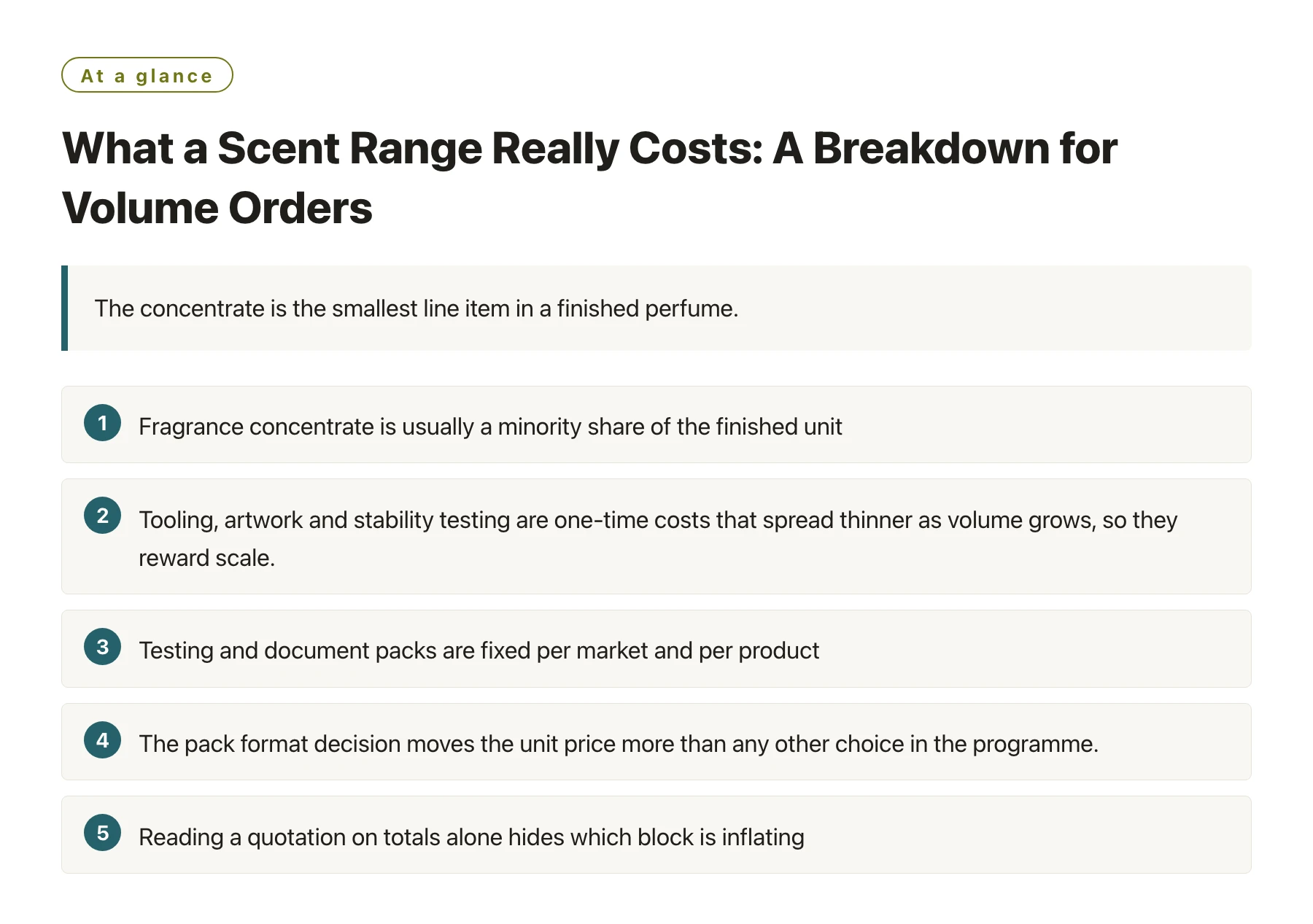
Key takeaways
- Fragrance concentrate is usually a minority share of the finished unit; packaging and decoration dominate the per-unit cost.
- Tooling, artwork and stability testing are one-time costs that spread thinner as volume grows, so they reward scale.
- Testing and document packs are fixed per market and per product, and they do not drop with order size.
- The pack format decision moves the unit price more than any other choice in the programme.
- Reading a quotation on totals alone hides which block is inflating; the breakdown is the comparison.
Ask ten buyers what a bottle of perfume costs to make and nine will start with the juice. Ask the same ten after a year in production and most will have revised their answer, because the components around the juice decide the unit price far more than the formula does.
This is a map of the five cost blocks in a fragrance programme, written for someone who needs a budget that survives contact with a real quotation.
The five cost blocks of a fragrance programme
Every quotation for a finished, filled, decorated product can be divided into five blocks. Knowing which block each number belongs to is what turns a price into a plan.
The first block is the concentrate itself: the fragrance oil, the alcohol or carrier, and the compounding labour. It is the smallest of the five in most volume programmes. The second is the pack: bottle, closure, pump, decoration, carton and any secondary packaging. The third is filling and assembly, which includes the line time, the quality checks and the rejects margin. The fourth is testing and documentation: stability, compatibility, safety assessment and the market files. The fifth is logistics: freight, warehousing and any local duties.
Why the packaging block decides the budget
Packaging choices cascade. A stock bottle with a standard collar and cap costs a fraction of a custom mould that then has to be amortised over the first order. Decoration adds its own layer — screen printing, hot stamping, lacquer — and each layer has a minimum and a lead time. The cost conversation in fragrance is therefore mostly a packaging conversation.
It is also increasingly a compliance conversation: the EU's packaging and packaging waste rules have been pushing producers to design packaging with their end-of-life obligations in mind [1], which means the cheap-looking pack can quietly carry future obligations.
Where the fixed costs live
Tooling, artwork, stability testing and the safety assessment are largely one-time costs per product and per market. They are the same whether the first order is ten thousand units or fifty thousand, which is mathematically why volume discounts exist. The buyer who understands this stops negotiating the one-time costs and starts managing them: freezing artwork and formula earlier genuinely saves money — the same discipline a manufacturer like Xuelei Fragrance applies when quoting a range.
The five blocks at a glance
| Cost block | What it covers | Where it usually bites |
|---|---|---|
| Concentrate | Fragrance oil, carrier, compounding | Rarely the surprise; rises only with dosage and exotic materials |
| Packaging | Bottle, closure, decoration, carton | Custom moulds and decoration layers inflate it fast |
| Filling and assembly | Line time, quality checks, rejects | Small runs make it per-unit expensive |
| Testing and documents | Stability, safety assessment, market files | Fixed per market; does not shrink with volume |
| Logistics | Freight, warehousing, duties | Per-unit but rarely negotiated until late |
A quotation that refuses to split into these five blocks is a quotation you cannot compare. The total tells you the price; the blocks tell you what you are actually buying.
Unit price versus programme cost
Once the blocks are visible, two numbers matter: the unit price at the planned volume, and the total programme cost across one-time and recurring items. They answer different questions. The unit price decides competitiveness; the programme cost decides whether the project is worth doing at all.
The methodical side of this — how formulation, dosage and materials interact with cost — is documented continuously in the trade press, with journals such as Cosmetics & Toiletries covering the formulation science behind the finished product [2]. The same discipline applies to the buyer's side: the cost model should be as carefully maintained as the formula.
The savings that hide in a single line
Most units within the pack block carry hidden levers: a standard closure instead of a custom one, a shared bottle across two SKUs, a decoration reduced from three colours to one. Each line is small; together they routinely move the unit price more than a round of concentrate negotiation. Ask suppliers where the standard components are — the answer is usually worth more than the discount you were about to request.
How ODM changes the cost shape
A factory that already holds developed bases, moulds and pack formats can remove or share the one-time lines entirely. That is the financial logic of choosing an ODM partner for fragrance brands: the model converts fixed development cost into a per-unit price, which is ideal when the first volume is uncertain and bad when the brand intends to own a formula for years.
Where a quote can hide costs
The classic hiding places are the ones the breakdown reveals: freight quoted ex-works, testing listed as an extra, minimums that force more units than the first season needs, and artwork charges that appear only after approval. When a number looks low, the question is not whether it is low — it is which block is missing. The discipline of reading Xuelei's guide is the same discipline as reading this article: name the block, then compare.
Build the model before the quote arrives. Fill in the five blocks with your own assumptions — unit price, tooling, testing, freight — and then read the quotation against your model. The gaps between the two are not mistakes; they are the negotiation.
Sources
- European Commission: Packaging Waste and the PPWR —— EU rules on packaging and packaging waste, including the Packaging and Packaging Waste Regulation requirements on recyclability and design.
- Cosmetics & Toiletries —— A technical magazine for cosmetic formulators, covering ingredients, formulation science and testing methods.
Frequently asked questions
Why is packaging such a large share of perfume cost?
Because perfume is sold on presentation. The bottle, closure, decoration and carton carry the brand message, and each element has material, tooling and minimum costs that the concentrate does not. In most volume programmes packaging outweighs the juice.
What are the one-time costs in a fragrance programme?
Tooling for custom moulds, artwork and plates, stability testing, the safety assessment and the initial document packs. They are per product and per market, so they spread thinner as the order grows — the mechanical reason volume pricing exists.
How much does testing add to a perfume budget?
It depends on the markets and the product form, but treat it as a fixed layer per product rather than a per-unit line. It does not shrink with volume, so it matters most on small programmes and least on large ones.
Is ODM cheaper than OEM for a first range?
Usually on paper, because the factory reuses developed bases and existing tooling instead of billing development separately. The trade-off is ownership and exclusivity; the cost shape is only half the decision.
What should I do with the breakdown once I have it?
Compare it line by line against your own model and against the other candidates' breakdowns. The block that differs most between quotations is the block the supplier genuinely controls — and the one worth negotiating.