
Wood Grain and Solid Colour Options on Fibreboard Panels
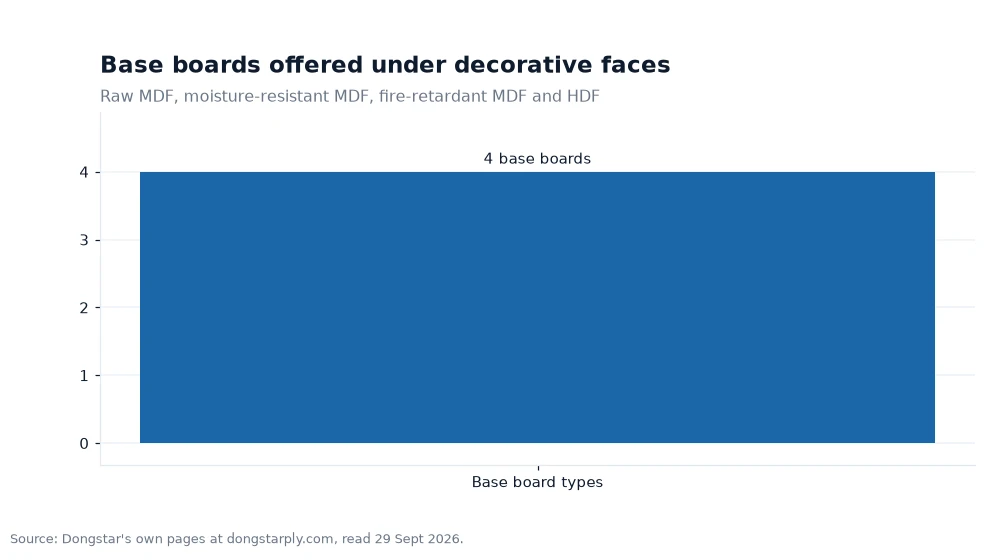
Dongstar's fibreboard range offers solid tones, wood grain effects, and fabric or marble looks on top of four base boards — raw MDF, moisture-resistant MHR MDF, fire-retardant FR MDF and high-density HDF. Sheets run 1220 × 2440 mm as standard, with 2100 × 2500 mm quoted at 9 mm and below, and a thickness window of 2 mm to 30 mm. Colour and core are two separate lines on the order.

Key takeaways
- Three decor families are published: solid colour, wood grain, and fabric or marble effects.
- Solid tones include grey, white, black, red, blue, orange, green and yellow.
- Wood grains listed include beech, cherry, walnut, teak, oak, maple, sapele, wenge and rosewood.
- Any decor can sit on four cores: MHR MDF, FR MDF, HDF or raw MDF.
Three decor families in one catalogue
Colour is where most panel projects actually start. The published offer sorts into three groups: solid tones that read as one flat colour, wood-grain prints that copy a species, and effects such as fabric and marble that sit between the two. The range is wide enough that the useful first step is not choosing a shade but deciding which family the room belongs to — a clinic corridor, a kitchen and a hotel bedroom rarely want the same one.
Behind the decor on a Medium Density Fibreboard panel sits a base board, and the sheet lists four: raw MDF, a moisture-resistant MHR MDF core, a fire-retardant FR MDF core, and HDF. Face material is a third decision, with melamine paper, HPL, PVC and leather all appearing as options, applied to one side or both. A specification that names all three levels — decor, face, core — is one a mill can quote without guessing.
Solid tones: what they ask of a workshop
Solid colours are the hardest decor to hide mistakes under. With no grain to interrupt the eye, a joint line, a handle position set 3 mm off centre, or a filler patch on a cut edge all become visible at conversational distance. The listed solid tones run from grey, white and black through red, blue, orange, green and yellow — a set that suits office furniture, school cabinets and shopfitting where a brand colour has to repeat across many units.
The compensation is planning freedom. A solid face does not care which way the sheet is oriented, so offcuts can be rotated to fit a cutting list without the grain running the wrong way. That single property can lift the yield of a job noticeably, and it is the main reason solid decor stays popular in flat-pack and contract furniture work where the same carcass is produced in large numbers.
Wood grains and the direction problem
Wood-grain faces are printed, not sawn, so the species list is generous: beech, cherry, walnut, teak, oak, maple, sapele, wenge and rosewood among them. Each print carries a direction, and that direction has to be respected across a run. Two doors hung side by side with the grain running opposite ways will look wrong to almost anyone who sees them, even if nobody can say why.
Grain direction is also a yield constraint. A cutting plan that rotates every offcut to fill a sheet will produce a run of doors with mixed grain, so the nesting software has to be set to keep the pattern aligned. Buyers ordering a large contract run should say so when they enquire, because the waste allowance for a directional decor is genuinely higher than for a flat one.
Fabric and marble effects, and the finishes around them
Fabric and marble effects solve a specific commercial problem: a client who wants the look of a textured wall or a stone surface without the weight, the cost or the fragility of the real thing. Both are available as printed faces on the same board, and both work best over large panels, where the pattern reads as a plane rather than as a repeat. Wall decor, reception counters and bathroom vanity units are the obvious applications.
How the surface is finished changes the effect. Matt and smooth treatments keep a marble print flat and believable, while textured, embossed and magic treatments give a fabric or stone pattern physical relief that catches light from an angle. The five treatments are listed alongside the decors, so the sensible order is to fix the look first and then choose the surface that presents it in the right light.
The core under the colour still has to be chosen
A decorative face does nothing for a panel that meets the wrong conditions. The four cores are different products with different jobs: raw MDF for dry interiors, MHR MDF in green for rooms where moisture is present, FR MDF in red where an interior fire brief applies, and HDF in black where the surface takes traffic. Colour choice and core choice are independent, which means the same decor can be ordered in four different ways.
Once the face is pressed on, the core is no longer visible, so the colour coding on the raw board is the last chance to check before machining. For anyone ordering a mixed pallet — say 40 sheets of a walnut effect on green core and 40 on raw — the order line should carry the core as well as the decor, and the packing list should repeat it. That is the difference between a delivery a fitter can use straight away and one that needs a phone call.
| Decor family | Listed examples | Where it tends to be used |
|---|---|---|
| Solid colour | Grey, white, black, red, blue, orange, green, yellow | Office furniture, contract cabinets, shopfitting |
| Wood grain | Beech, cherry, walnut, teak, oak, maple, sapele, wenge, rosewood | Kitchens, wardrobes, tables, wall panels |
| Fabric effect | Textile patterns over a printed face | Wall decor, acoustic linings, headboards |
| Marble effect | Stone patterns over a printed face | Vanity units, counters, feature walls |
| Surface treatment | Matt, textured, glossy, embossed, magic | Sets how the decor reads under room light |
Worked example: 30 wardrobe doors in a grain finish
A wardrobe run needs 30 doors at 600 × 2000 mm in a walnut effect. Per door that is 0.6 m × 2.0 m = 1.2 m², so the run covers 30 × 1.2 = 36 m² of finished face (example). Ripping a 1220 × 2440 mm sheet gives two 600 mm strips across its width, and each strip yields one 2000 mm door along the length with 440 mm left over, so the sheet produces two doors (example). Thirty doors therefore need 15 sheets, and the leftover strips cover the plinths.
The grain direction is what makes that plan work or fail. Cutting the doors along the sheet length keeps the pattern vertical on every door, which is why the sheet is ripped into lengthwise strips rather than crosscut. Run the same job across 40 identical doors and the arithmetic stays simple — 20 sheets — but the offcut pile grows, and in a directional decor those offcuts cannot be turned to fit somewhere else.
Frequently asked questions
Are solid colours easier to work with than wood grains?
Usually, yes. A solid decor has no direction, so offcuts can be rotated to suit a cutting list and the yield is higher. Grains must stay aligned across a run, which means a bigger waste allowance on the same job.
Can the same decorate be ordered on different cores?
Yes. The decor is a face choice and the core is a separate one, so a walnut effect can be pressed onto raw MDF, MHR MDF in green, FR MDF in red or HDF in black depending on where the panel is going.
Why does the surface treatment change a printed decor?
Because the treatment controls how light hits the print. Matt and smooth surfaces keep a marble or wood pattern flat and even, while textured, embossed and magic surfaces add relief that makes the same pattern read deeper from an angle.
Fix the look, then fix the core
Colour is the visible half of the specification and the half that gets agreed first, but it should never travel alone. Buyers who write the decor, the face material and the base board on the same line receive a sheet they can machine on arrival, and the wider plywood and board range gives the equivalents for other applications. Where a project needs a printed decor over a stable core and a matching edge, the melamine-faced sheets are the closest comparison.
Decor lists, core options and finish names in this article derive from the company's own site, read 29 Sept 2026, and carried into the table above, for the numbers in this briefing[1].