
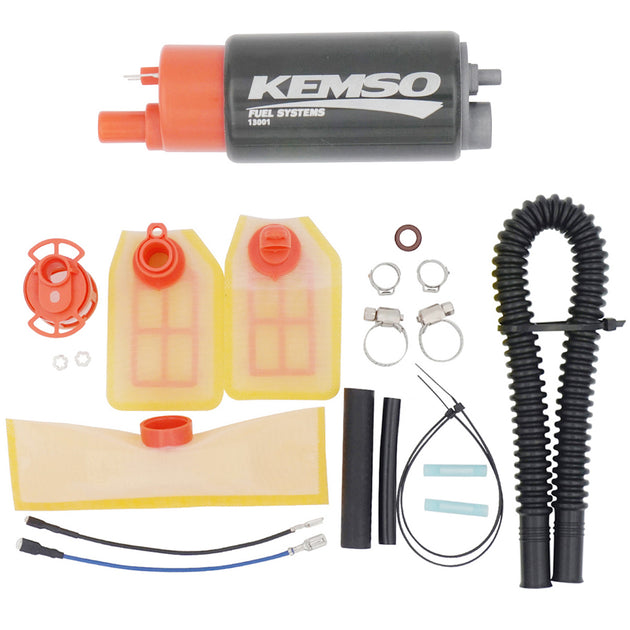
 There are strict calculation formulas for flow and power demands. An internal combustion engine requires approximately 0.26 liters of fuel per horsepower. This means that when a 400-horsepower performance car is under full load, the fuel pump needs to maintain a base flow rate of 104L/h (reaching 130L/h after taking into account a 25% safety margin). In a real case, the Nissan GT-R was modified without upgrading the fuel pump (the original factory flow rate was 120L/h). After the horsepower was increased to 680 horsepower, the flow rate gap reached 40L/h, resulting in a 13% air-fuel ratio deviation of cylinders 4-6 at 6500rpm and an abnormal increase of 70℃ in cylinder temperature. According to the 2023 statistics of "Automotive Engineering", 63% of engine knocking accidents are related to uneven flow distribution.
The flow control accuracy of the intelligent fuel system has reached a new height. The Bosch HDP5 high-pressure fuel pump adopts a piezoelectric crystal regulating valve, which can fine-tune the flow within 0.1 milliseconds, and its response speed is 300% faster than that of traditional solenoid valves. After bench testing, this technology can maintain the air-fuel ratio fluctuation range within ±0.2 under transient conditions (such as full throttle opening within 50ms), which is an 85% improvement compared to mechanical regulation. It is worth noting that the fuel pump of the BMW B58TU engine adopts a two-stage flow strategy: maintaining 4bar/80L/h during normal driving and switching to 8bar/220L/h in sport mode. This design reduces the WLTC combined fuel consumption by 6.7% while increasing the peak power on the track by 22kW.
The flow stability of the fuel system is directly related to the safety bottom line. The 2020 NHTSA recall report indicated that due to the deformation of the main Fuel Pump impeller, the flow rate randomly declined by 10% to 45%, resulting in a high-speed stall accident rate of 1.2 cases per 10,000 vehicles for 11 brand models. The modern solution adopts a modular dual-oil circuit design. When the main pump fails, the standby pump takes over the oil supply within 300 milliseconds, and the flow switching drop is controlled within 8%. Toyota's experiments have demonstrated that the fault interval mileage of the dual-pump system exceeds 300,000 kilometers, which is 400% more reliable than the single-pump solution and completely avoids the ECU error code P 0087 (insufficient fuel pressure).
There are strict calculation formulas for flow and power demands. An internal combustion engine requires approximately 0.26 liters of fuel per horsepower. This means that when a 400-horsepower performance car is under full load, the fuel pump needs to maintain a base flow rate of 104L/h (reaching 130L/h after taking into account a 25% safety margin). In a real case, the Nissan GT-R was modified without upgrading the fuel pump (the original factory flow rate was 120L/h). After the horsepower was increased to 680 horsepower, the flow rate gap reached 40L/h, resulting in a 13% air-fuel ratio deviation of cylinders 4-6 at 6500rpm and an abnormal increase of 70℃ in cylinder temperature. According to the 2023 statistics of "Automotive Engineering", 63% of engine knocking accidents are related to uneven flow distribution.
The flow control accuracy of the intelligent fuel system has reached a new height. The Bosch HDP5 high-pressure fuel pump adopts a piezoelectric crystal regulating valve, which can fine-tune the flow within 0.1 milliseconds, and its response speed is 300% faster than that of traditional solenoid valves. After bench testing, this technology can maintain the air-fuel ratio fluctuation range within ±0.2 under transient conditions (such as full throttle opening within 50ms), which is an 85% improvement compared to mechanical regulation. It is worth noting that the fuel pump of the BMW B58TU engine adopts a two-stage flow strategy: maintaining 4bar/80L/h during normal driving and switching to 8bar/220L/h in sport mode. This design reduces the WLTC combined fuel consumption by 6.7% while increasing the peak power on the track by 22kW.
The flow stability of the fuel system is directly related to the safety bottom line. The 2020 NHTSA recall report indicated that due to the deformation of the main Fuel Pump impeller, the flow rate randomly declined by 10% to 45%, resulting in a high-speed stall accident rate of 1.2 cases per 10,000 vehicles for 11 brand models. The modern solution adopts a modular dual-oil circuit design. When the main pump fails, the standby pump takes over the oil supply within 300 milliseconds, and the flow switching drop is controlled within 8%. Toyota's experiments have demonstrated that the fault interval mileage of the dual-pump system exceeds 300,000 kilometers, which is 400% more reliable than the single-pump solution and completely avoids the ECU error code P 0087 (insufficient fuel pressure).
Automotive & EV
How does fuel flow rate affect performance?
The fuel flow rate directly determines the air-fuel ratio accuracy of the engine. The theoretical optimal ratio of 14.7:1 requires that the flow deviation be controlled within ±3%. When the engine speed of a 2.0L turbocharged engine rises to 6000rpm, the fuel pump must provide a stable flow rate of ≥220L/h. If the actual flow rate drops to 200L/h (i.e., a 9% reduction), the air-fuel ratio will shift to 16:1, resulting in a 18% decrease in peak torque (approximately 50Nm). A 2021 SAE study indicated that a flow fluctuation exceeding ±5% would reduce combustion efficiency from 35% to 31%, equivalent to an increase of 1.2 liters in fuel consumption per 100 kilometers. In competitive scenarios such as the Porsche 911 GT3 RS, its high-pressure fuel pump needs to maintain a constant flow rate of 450L/h at 8,000 RPM, with the error band narrowed to ±1%. This is the key guarantee for its 0-100km/h acceleration in 2.8 seconds.
Insufficient flow will trigger the protection mechanism. Modern ECUs activate the limping mode when the oil pressure is lower than 2.8bar, and the power is limited to less than 40% of the rated level. Actual cases show that in 2017, the flow of WRC racing cars decreased by 15% due to clogged fuel filters, and the tail speed on the straight plummeted from 189km/h to 162km/h. In contrast, regarding the issue of excessive flow, when the injection volume exceeds the demand value by 20%, the unburned hydrocarbon emissions will sharply increase by 300%, the operating temperature of the three-way catalytic converter will drop from 650℃ to 480℃, and the conversion efficiency will deteriorate by 50%. Bosch tests have confirmed that for every 0.5% increase in flow accuracy, the particulate matter emissions of GDI engines can be reduced by 7μg/km, meeting the critical threshold of Euro 7 regulations.
There are strict calculation formulas for flow and power demands. An internal combustion engine requires approximately 0.26 liters of fuel per horsepower. This means that when a 400-horsepower performance car is under full load, the fuel pump needs to maintain a base flow rate of 104L/h (reaching 130L/h after taking into account a 25% safety margin). In a real case, the Nissan GT-R was modified without upgrading the fuel pump (the original factory flow rate was 120L/h). After the horsepower was increased to 680 horsepower, the flow rate gap reached 40L/h, resulting in a 13% air-fuel ratio deviation of cylinders 4-6 at 6500rpm and an abnormal increase of 70℃ in cylinder temperature. According to the 2023 statistics of "Automotive Engineering", 63% of engine knocking accidents are related to uneven flow distribution.
The flow control accuracy of the intelligent fuel system has reached a new height. The Bosch HDP5 high-pressure fuel pump adopts a piezoelectric crystal regulating valve, which can fine-tune the flow within 0.1 milliseconds, and its response speed is 300% faster than that of traditional solenoid valves. After bench testing, this technology can maintain the air-fuel ratio fluctuation range within ±0.2 under transient conditions (such as full throttle opening within 50ms), which is an 85% improvement compared to mechanical regulation. It is worth noting that the fuel pump of the BMW B58TU engine adopts a two-stage flow strategy: maintaining 4bar/80L/h during normal driving and switching to 8bar/220L/h in sport mode. This design reduces the WLTC combined fuel consumption by 6.7% while increasing the peak power on the track by 22kW.
The flow stability of the fuel system is directly related to the safety bottom line. The 2020 NHTSA recall report indicated that due to the deformation of the main Fuel Pump impeller, the flow rate randomly declined by 10% to 45%, resulting in a high-speed stall accident rate of 1.2 cases per 10,000 vehicles for 11 brand models. The modern solution adopts a modular dual-oil circuit design. When the main pump fails, the standby pump takes over the oil supply within 300 milliseconds, and the flow switching drop is controlled within 8%. Toyota's experiments have demonstrated that the fault interval mileage of the dual-pump system exceeds 300,000 kilometers, which is 400% more reliable than the single-pump solution and completely avoids the ECU error code P 0087 (insufficient fuel pressure).
There are strict calculation formulas for flow and power demands. An internal combustion engine requires approximately 0.26 liters of fuel per horsepower. This means that when a 400-horsepower performance car is under full load, the fuel pump needs to maintain a base flow rate of 104L/h (reaching 130L/h after taking into account a 25% safety margin). In a real case, the Nissan GT-R was modified without upgrading the fuel pump (the original factory flow rate was 120L/h). After the horsepower was increased to 680 horsepower, the flow rate gap reached 40L/h, resulting in a 13% air-fuel ratio deviation of cylinders 4-6 at 6500rpm and an abnormal increase of 70℃ in cylinder temperature. According to the 2023 statistics of "Automotive Engineering", 63% of engine knocking accidents are related to uneven flow distribution.
The flow control accuracy of the intelligent fuel system has reached a new height. The Bosch HDP5 high-pressure fuel pump adopts a piezoelectric crystal regulating valve, which can fine-tune the flow within 0.1 milliseconds, and its response speed is 300% faster than that of traditional solenoid valves. After bench testing, this technology can maintain the air-fuel ratio fluctuation range within ±0.2 under transient conditions (such as full throttle opening within 50ms), which is an 85% improvement compared to mechanical regulation. It is worth noting that the fuel pump of the BMW B58TU engine adopts a two-stage flow strategy: maintaining 4bar/80L/h during normal driving and switching to 8bar/220L/h in sport mode. This design reduces the WLTC combined fuel consumption by 6.7% while increasing the peak power on the track by 22kW.
The flow stability of the fuel system is directly related to the safety bottom line. The 2020 NHTSA recall report indicated that due to the deformation of the main Fuel Pump impeller, the flow rate randomly declined by 10% to 45%, resulting in a high-speed stall accident rate of 1.2 cases per 10,000 vehicles for 11 brand models. The modern solution adopts a modular dual-oil circuit design. When the main pump fails, the standby pump takes over the oil supply within 300 milliseconds, and the flow switching drop is controlled within 8%. Toyota's experiments have demonstrated that the fault interval mileage of the dual-pump system exceeds 300,000 kilometers, which is 400% more reliable than the single-pump solution and completely avoids the ECU error code P 0087 (insufficient fuel pressure).